
TOPPING-OUT CEREMONY FOR THE NAVITAS BUILDING
Three years ago, murky water was lapping at the dock. Today, a 38,000-square-metre star-shaped building is now waiting for students, researchers and companies to move in by 2014. The topping-out ceremony for Aarhus University’s new waterfront engineering building in Aarhus was held on Monday 3 December.

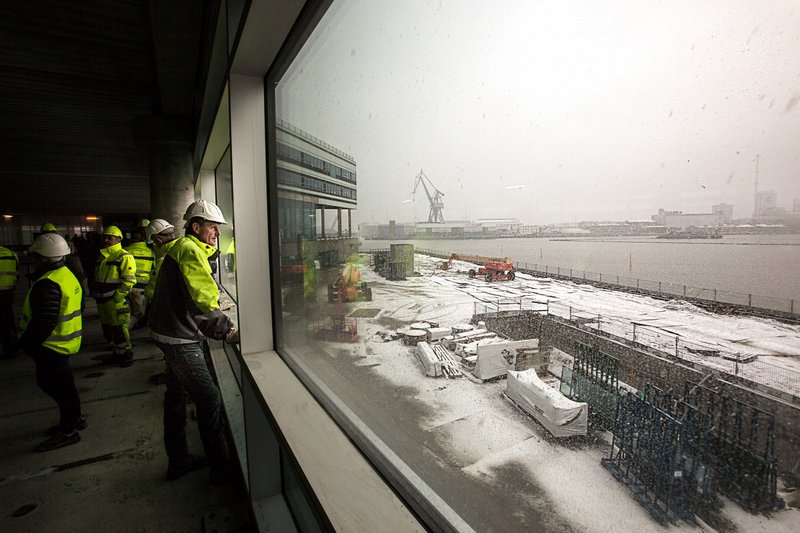
"Navitas is one of the most distinctive and visionary buildings in Aarhus, and we’re pleased to be able to offer researchers and students such a unique framework, which will stimulate new ideas and innovation,” said Dean Brian Bech Nielsen in his speech to the workmen and the large crowd that turned up.
Backing the construction of the Navitas building are Aarhus University, the Aarhus School of Marine and Technical Engineering, and the INCUBA Science Park.
According to plan, the building will be ready for moving in by summer 2014, and will subsequently become the hub of the university’s research and education activities in energy technology.
Hub for energy technology
There are great expectations to the Navitas building. The aim is to set up a Danish and international hub for energy technology.
“Navitas is a new framework for growth. Developing the energy technologies of the future will take place here, and researchers, students and companies will contribute to finding new solutions to how we can reduce greenhouse gas emissions and achieve more effective use of our sustainable energy sources,” said Mayor Jacob Bundsgaard in his speech.
The Navitas building will be home to the Department of Engineering and the Aarhus University School of Engineering, and there are also great expectations to this new knowledge environment.
“It’ll be a top-class international development laboratory, and we hope it can help attract talented students, researchers and companies from all over the world. The building is almost finished, but there’s still a good deal of work ahead if we’re to achieve our goal of creating an innovative campus environment and contributing significantly to the development of the Danish energy sector,” says Director Conni Simonsen, Aarhus University School of Engineering.
The Navitas building is eight storeys high and will include facilities for education, research and entrepreneurship. Approximately 2800 students, researchers and company employees will work and study here.
About Navitas
Education
The Navitas building will provide facilities for
- the Aarhus School of Marine and Technical Engineering’s education programmes
- three of the School of Engineering’s Bachelor’s degree programmes: Civil and Structural Engineering, Architectural Engineering and Mechanical Engineering
- two of the School of Engineering’s Master’s degree programmes: Applied Mechanics and Architectural Engineering
Laboratory
The building will be its own energy laboratory with in-built advanced technology hardware worth millions. The bearing structures, cooling system, ventilation system and energy management systems will be accessible to both researchers and students.
Research and development
The research activities in Mechanical Engineering and Civil and Architectural Engineering at Aarhus University’s Department of Engineering will be located in the Navitas building. Research and development activities in strong collaboration with the business sector will be the lifeblood of Navitas. The aim is to make significant contributions to the development of the Danish energy sector.
Science park
Navitas will have its own science park, with a focus on companies that have direct or indirect affiliation with the energy sector. The research park will include both a project hotel and a student entrepreneurship incubator.
Read more about Navitas here.