
"Graduating with that kind of CV? That’s pretty attractive"
Aarhus University's new Professional Master’s programme lets engineering students gain industry experience while completing their degrees - and companies are eager to join.

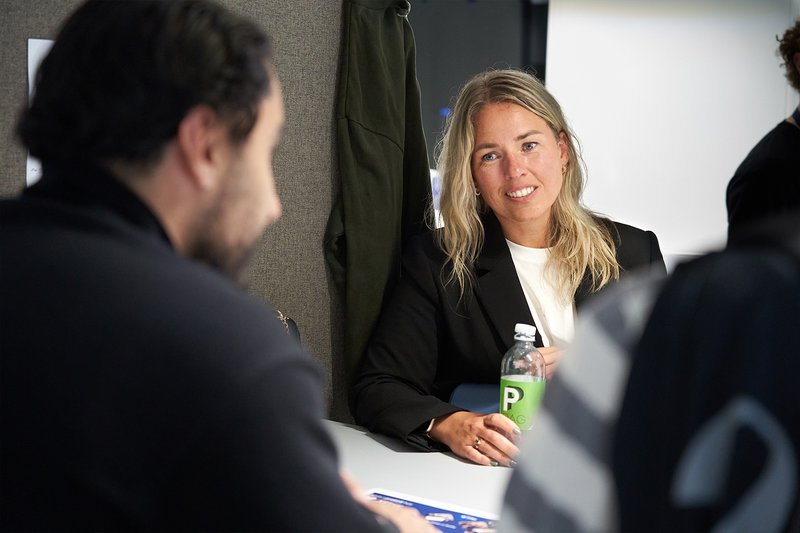
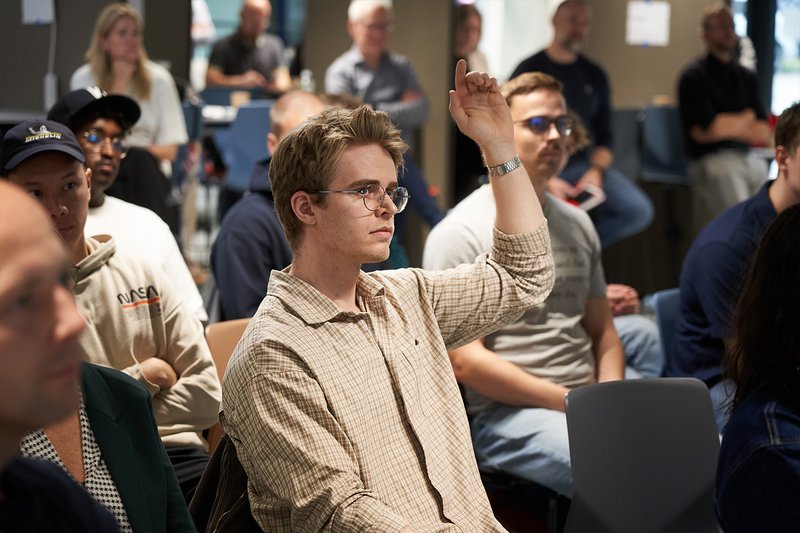
The auditorium was buzzing with curiosity as students and company representatives gathered for Aarhus University’s very first Professional Master’s Day at the Department of Electrical and Computer Engineering. The event drew a full house of students eager to explore a new career path that lets them work part-time in a company while finishing their MSc in Engineering, and companies were just as interested in meeting them.
On stage, programme directors and business partners addressed a wide range of practical questions, from contracts and job security to weekly time commitments and academic expectations. In the audience, students weighed the promise of paid, hands-on industry experience against the challenges of balancing work and study.
“I heard you can take your Master’s degree while reducing your working hours just a bit. That sounds really interesting,” said Thomas Norup, a student of software engineering currently on an internship.
He wasn’t alone. For many students, the Industry Master’s programme offers an appealing combination of financial stability and career-building experience.
“I’m running out of student grant money,” said Oliver Christensen. “The idea of working part-time and getting paid while I study - that gives me both peace of mind and freedom.”
Bridging study and employment
The new model enables students to work part-time in a company while pursuing a part-time MSc degree. This means they graduate with not only academic credentials but also several years of relevant industry experience and a stronger sense of how theory meets practice.
“The hands-on part is what really appeals to me,” said Emil Andersen. “Being embedded in a company for years while you study - that’s a powerful combination.”
Some students, who might otherwise have skipped the Master’s degree to enter the workforce right away, are now reconsidering their plans.
“I wasn’t planning to do a Master’s at all,” said Daniel Zanini, a third-semester software student. “But this? This makes sense. It’s a really practical solution.”
His classmate Anita Mguyen agreed: “I just heard about it yesterday, and it actually sounds exciting. I could definitely see myself going this route.”
Ruben Guldgård, also in software engineering, added: “I’m at a point where I’m considering whether to do a Master’s or not. I’ve just finished an internship and I really like gaining experience while studying. Graduating with that kind of CV? That’s pretty attractive.”
Companies see long-term potential
Employers, too, turned up in large numbers. Companies like AGCO, Beumer Group, Visma, and HyBess Energy used the opportunity to scout talent and learn more about how the new scheme works.
“This is a really smart way to recruit,” said Kenneth Jensen from AGCO. “We gain access to young people with fresh knowledge, and they get to grow with us over time. It’s a win-win.”
Mette Nielsen from Visma echoed the point: “When students are part of the team for years, you get to know them on a deeper level. That’s valuable, and we need both more people and the right people.”
Søren Holm from Beumer Group sees the Industry Master’s scheme as a chance to retain talent: “We already bring in a lot of students during their studies. If they can stay and level up with us - that’s a major advantage. Good engineers are hard to find.”
A new bridge between academia and industry
For Mikael Bergholz Knudsen, Head of Department, the turnout confirmed that the programme meets a real need.
“We have a responsibility to offer engineering degrees that reflect the real world,” he said. “This model offers something unique for both students and businesses. It creates new career paths, new partnerships, and new links between research and practice.”
He sees the programme as more than just a recruitment tool: “It’s a way to strengthen our technological ecosystem by forging long-term connections.”
A flexible, practical and academically ambitious future
The volume and range of questions during the event showed that students are thinking deeply and seriously about the new opportunity. Far from seeing it as a compromise, many are beginning to view it as a new standard for how an MSc can be done.
“I like the idea of doing something practical while studying, so it doesn’t get too abstract,” said Daniel le Fevre, a computer engineering student. “It helps you see the point of all the theory.”
Torben Bjerre, CEO of HyBess Energy, shared that curiosity: “It’s an interesting way to bring in new people - people with energy and knowledge. It makes sense to us.”
More information
Interested in applying for the Industry Master’s in Engineering at Aarhus University? READ MORE here.