
A sense of touch could help robots handle the unexpected
Robots have become remarkably good at understanding images and instructions. But many still struggle to use touch to respond reliably when physical conditions change. In a new research project, researchers at Aarhus University and the University of Southern Denmark will combine adaptive AI with soft robotic skin to help robots detect unexpected physical changes and respond before something goes wrong.

Imagine a robot lifting a fragile container. Its camera tells it that the object is securely in its grasp. But the surface is more slippery than expected, and the container has already started to slide between the robot’s fingers.
A human would feel this almost immediately and adjust their grip. For many robots, however, these subtle physical changes are much harder to detect.
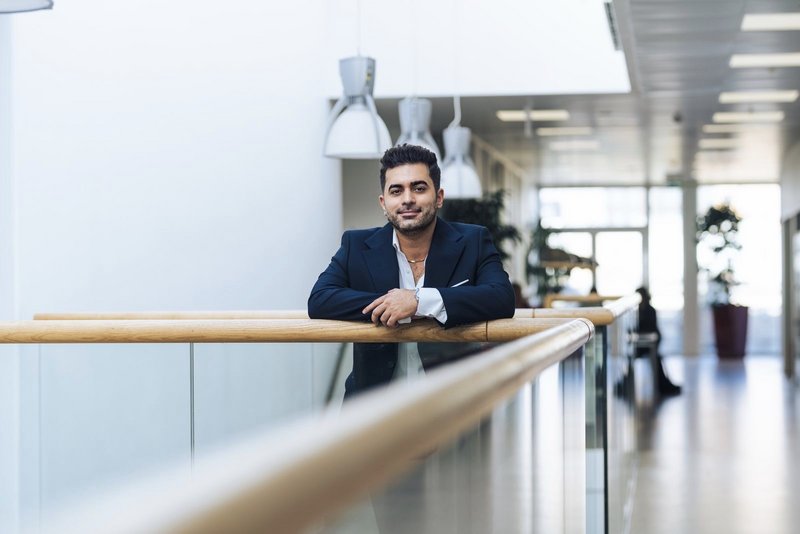
Associate Professor Behzad Bozorgtabar from Aarhus University wants to change that. He has received DKK 7.2 million from Independent Research Fund Denmark for STORM, a new project bringing together researchers from Aarhus University and the University of Southern Denmark to combine artificial intelligence with a new type of soft, fluid-filled robotic skin.
“Robots can perform impressive tasks, but many still struggle when the physical situation changes – for example, when an object is more slippery or fragile than expected. Something can look perfectly secure through a camera while it is already starting to slip. With STORM, we want robots to recognise these hidden changes through touch and adjust their actions while working, including knowing when to stop,” says Behzad Bozorgtabar.
A robotic skin with a physical memory
The tactile skin contains tiny channels filled with liquid. When the robot grasps an object, the pressure in the liquid changes. By tracking how these pressure signals develop over time, the researchers aim to give the robot a form of short-term physical memory that can reveal when physical contact develops differently from what the robot expects.
“We want the robot to use this short ‘memory’ of contact to compare what it expects to feel with what it actually feels. Cameras help it see an object; touch helps it judge what is happening where the gripper meets it, even when that contact is hidden from view,” says Behzad Bozorgtabar.
If a slippery container begins to slide, for example, the aim is for the robot to detect the change early enough to adjust its grip or slow down.
“If the adjustment risks squeezing too hard, or the robot is uncertain about what is happening, it should stop safely,” says Behzad Bozorgtabar.
Knowing when to stop
The ability to recognise and respond to uncertainty is a central part of STORM. The researchers will develop a safety system that evaluates proposed adjustments before they are carried out and assesses when stopping is the safer option.
This could be particularly important in environments where robots work alongside people and must adapt to changing conditions.
“Shared workplaces are full of changes: people move, objects vary, and contact does not always happen as expected. Robots need to respond to those changes without applying excessive force or continuing an unreliable action. This could make them more useful partners in manufacturing and, eventually, in laboratory or healthcare-support tasks involving delicate objects. Recognising uncertainty is an essential part of that,” says Behzad Bozorgtabar.
STORM is led by Bozorgtabar’s Adaptive & Agentic AI (A3) Lab at Aarhus University, in collaboration with Professor Ahmad Rafsanjani and his team at the University of Southern Denmark (SDU). It combines AU’s expertise in adaptive AI with soft tactile sensing technology developed by Rafsanjani’s team.
By the end of the three-year project, the researchers aim to demonstrate a robot that can use touch to recognise hidden risks and respond before something goes wrong.
“For me, the clearest sign of success would be a robot encountering an unexpected change and responding appropriately – completing the task when it can, and stopping when it cannot proceed reliably,” says Behzad Bozorgtabar.
Contact
Associate Professor Behzad Bozorgtabar
Department of Electrical and Computer Engineering
Mail: behzad@ece.au.dk
Tel.: +4520641553